
Welding Positioner Buying Guide: Capacity, Tilt, and Workflow Fit
For many fabrication shops, weld quality and throughput are limited less by the power source than by how consistently a joint can be presented to the welder. A **welding positioner** helps bring a secured workpiece to an appropriate welding and assembly angle, allowing controlled rotation and tilt instead of repeated manual repositioning. It can be a focused investment for job shops, component makers, and automation cells—but only if the selected configuration suits the weight, geometry, holding method, and sequence of the real work.
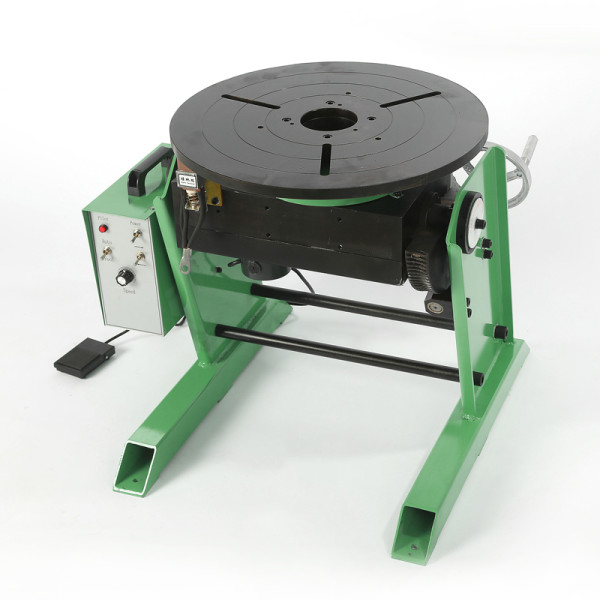
The [Welding Positioner](https://www.steelstructurer.com/pid18380531/Welding-Positioner.htm) is listed in YM-10/30/50/100/300/600 variants, so buyers should not treat the product name as a single capacity or configuration. Begin with a fact sheet for the parts you want to rotate: finished weight, center of gravity, outside diameter or envelope, clamping surface, and required welding orientations. Include the fixture weight, because the table supports the total rotating load rather than the part alone.## Start with safe, stable workholdingA positioner succeeds when the workpiece remains controlled through the entire rotation and tilt path. The published product details describe a table, slewing mechanism, and turning mechanism that bring fixed workpieces to a desired angle. The product page also lists an adapter chuck option, KC-65/KC-80, and says a welding chuck with adjustable welding-gun support can be furnished. Those details are useful prompts for a buyer’s review: how will the part be clamped, where will the fixture locate, and can the torch reach the joint without interfering with the chuck or support?Do not rely on part weight alone. An offset or unusually shaped assembly may create a more demanding turning condition than a centered cylindrical component of the same mass. Provide drawings or photographs of representative assemblies when requesting a recommendation. Confirm the rated configuration, fixture interface, permissible center-of-gravity offset, and operating procedure with the supplier before making a selection.## Choose rotation and tilt for the welding sequenceThe listed rotation speed is 2–16 r/min and the tilt range is 0–90°. In practice, a shop needs controlled movement that supports the chosen welding procedure and lets the operator place the joint where it can be performed reliably. The page describes variable-frequency stepless speed regulation and notes that the rotation structure is driven by a DC motor. Those are workflow advantages when an operator needs to set an appropriate rotation pace rather than work around a single fixed speed.The turning structure is described as worm-and-gear based, with self-locking and stepless turning from 0 to 90 degrees. Ask the supplier to demonstrate the actual sequence for your component: load it, clamp it, tilt it, rotate it, stop it for a pass, and return it for removal. This is much more revealing than inspecting a specification table. It will expose clearance needs, cable routing, operator reach, and whether the desired position can be held comfortably.## Plan for manual work and automationA welding turntable can improve manual welding ergonomics, but it can also become a useful part of an automated cell. SteelStructurer states that its positioner can be combined with a welding machine to form an automatic welding machine and can serve as a robot peripheral device. For an automation project, define the interface early: who commands rotation, how are fixtures indexed, where are the safe zones, and how does the cell confirm that the part is secured?The page also notes that an air-powered tail tip can be furnished for self-holding workpieces. Whether this accessory is appropriate depends on the actual part and process, so it should be treated as an item to evaluate rather than an assumed requirement. Likewise, the listed series includes roll, head-to-tail rotary, head-to-tail lifting, head-to-tail tilting, and double-turn types. The right form follows the part geometry and access requirements.## Build a clear RFQAn effective RFQ for a welding positioner includes photos or drawings, total rotating load including fixtures, center-of-gravity information, component dimensions, desired tilt and rotation sequence, preferred chuck or fixture approach, electrical supply, and whether the unit will connect to a welding robot. Add the highest and lowest production volumes expected, because fast changeovers may matter more than a specialized fixture on mixed work.Finally, look beyond the machine table. Budget for fixtures, guarding, cable management, operator training, and an acceptance test using representative parts. A positioner should make good weld access repeatable, not merely move a part more easily.Send SteelStructurer your representative workpiece drawings and workflow requirements to discuss the suitable configuration of the [Welding Positioner](https://www.steelstructurer.com/pid18380531/Welding-Positioner.htm) and the options needed for your shop.
