
MIG/MAG-400/500 Welding Machine Selection for Steel Fabrication Shops
When a fabrication team needs a production welding source, the purchase decision should start with the jobs being welded—not a model number alone. A **MIG/MAG-400/500 welding machine** can be considered for shops that need an integral-type, high-speed single-pulse MIG unit, but buyers should still match the selected model to the required current range, electrical supply, duty cycle, workspace, and the welding procedure their parts demand. A well-scoped review helps ensure the power source supports day-to-day production instead of becoming a mismatch at the first demanding job.
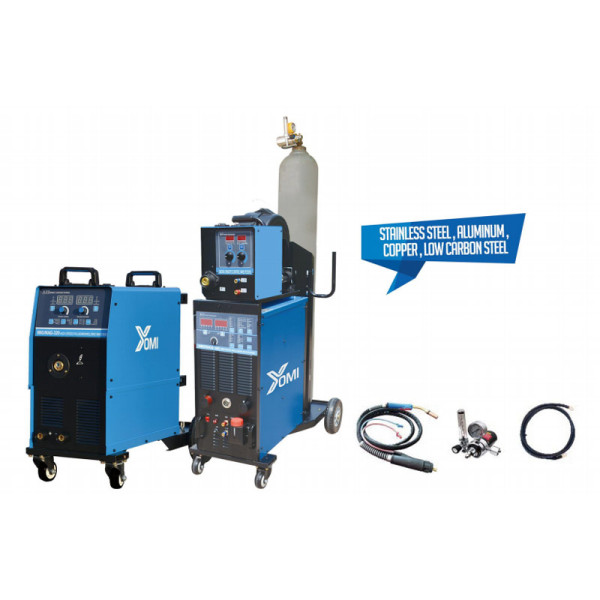
The [MIG/MAG-400/500 Welding Machine](https://www.steelstructurer.com/pid18376991/MIG-MAG-400-500-Welding-Machine.htm) is presented as an integral-type MIG/MAG-280/320/400/500 high-speed single-pulse MIG welding machine. The published 400 and 500 variants have different output figures, so first identify the process window that your qualified procedures and production schedule require. For the listed models, the working current range is 20–300 A for MIG/MAG400 and 20–400 A for MIG/MAG-500. The listed working-voltage ranges are 15.7–29 V and 15.7–34 V respectively.## Make output range a process questionIt is tempting to choose the largest available output range as a default. A better approach is to map the current and voltage needs of the welds you make most often, then include the heavier or less frequent jobs that could determine future capacity. Review the material types, joint designs, positions, wire sizes, shielding-gas practices, and required deposition rates with your welding engineer or procedure owner. The product page gives electrical ranges; it does not replace a procedure review.The listed wire-feeding speed is 18 m/min, with 90% efficiency and a 0.89 power factor. These are useful values for comparing the published models and for discussing facility readiness, but they should not be converted into unverified productivity promises. Actual output is affected by joint preparation, fit-up, welder technique, changeovers, consumables, and inspection requirements.## Verify power and duty-cycle compatibilityThe product page lists a three-phase 380 V ±15% supply at 50/60 Hz. Before procurement, have a qualified facility or electrical team confirm that the incoming supply, protective devices, cable routing, grounding, and planned installation location are appropriate for the selected machine. Electrical readiness should be confirmed before a machine arrives, especially where multiple welding stations may run together.The stated rated input power is 10.6 KVA for the 400 variant and 16.3 KVA for the 500 variant. The listed rated input current is 16.5 A for the 400 and 25.2 A for the 500. Rated duty cycle is 60%. These specifications should be included in a purchasing checklist alongside the production duty expected on the busiest shift. If the shop operates long, repetitive weld cycles, discuss the expected operating pattern and any required cooling or maintenance practices with the supplier.## Consider the work area and handling needsThe published dimensions are 945 × 513 × 1040 mm. Listed weights are 65.5 kg for the 400 and 67.5 kg for the 500. These details help plan the installation location, movement route, and service access. Confirm where cables, wire, gas cylinders, and any accessories will be placed so that the station remains orderly and operators can work safely.For multi-station fabrication, standardize the settings and consumable process where practical. This makes it easier to train operators, stock spares, and investigate quality variation. If the source will be used with a positioner, manipulator, or robot, describe the intended integration in the inquiry. The operational goal is a complete welding station with stable material flow, controlled setup, and clear quality checks.## Compare models using a buyer checklistAsk suppliers to confirm the exact model being quoted, the included torch and feeder configuration, compatible consumables, power connection requirements, commissioning scope, training, warranty terms, and service support. Request that the quoted configuration be demonstrated or discussed against representative weld coupons. Keep a record of the current, voltage, duty cycle, input power, dimensions, and weight for each option so the decision can be reviewed across production, maintenance, and purchasing.The correct MIG/MAG power source is the one that fits your qualified work, facility capacity, and expected daily load. It should give the shop a repeatable production tool, not force welders to compromise their normal process around the equipment.Share your material thickness range, welding procedures, shift demand, and site power details with SteelStructurer to confirm whether the [MIG/MAG-400/500 Welding Machine](https://www.steelstructurer.com/pid18376991/MIG-MAG-400-500-Welding-Machine.htm) and the appropriate output variant fit your fabrication requirements.
