
How to Choose an H Beam Laser Cutting Machine for High-Output Steel Fabrication
When fabrication schedules tighten, the biggest bottleneck is often not welding—it is preparing every beam accurately enough for the next operation. A modern H beam laser cutting machine can bring cutting, hole making, rat-hole cutting, beveling, and marking into one beam-processing step. For buyers building capacity for structural steel, the right choice is less about chasing a headline number and more about matching the machine’s working envelope, data workflow, and material range to the jobs that actually pass through the shop.
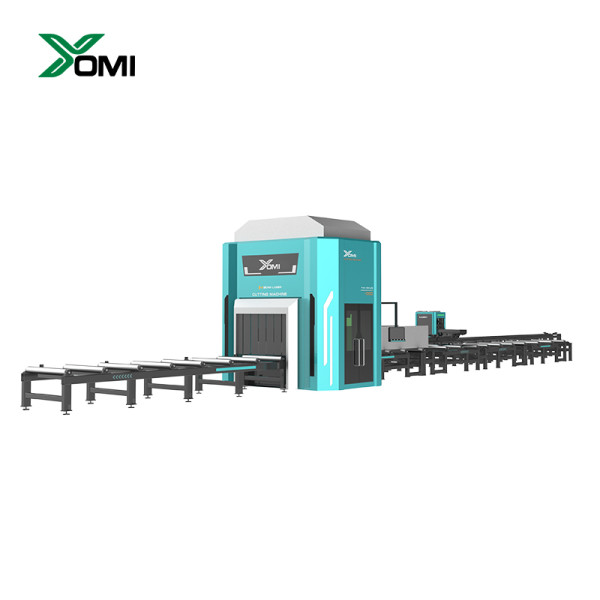
YOMI’s Intelligent H beam Laser Cutting Machine is designed for H-beam, I-beam, and channel-beam work. Its published model is YM-XHJG-1250, with a 100–600 mm flange-width range, 100–1250 mm workpiece height, and a maximum workpiece weight of 6,000 kg. Those figures give a practical starting point for determining whether the equipment fits your normal section mix before requesting a quotation.
Start with the beam profile and job mix
A fiber-laser beam cutter is a production asset, not a generic plate cutter. Begin with a representative month of released drawings: list the beam families, flange widths, section heights, lengths, weights, material thicknesses, and required features. The YM-XHJG-1250 lists a 1–30 mm cutting-thickness range and a ±45° bevel angle. That makes it important to separate the jobs that fall comfortably inside the published envelope from exceptional work that may require a different process or a separate handling plan.
Also look beyond simple cut-to-length work. The product page states that cutting off, bolt holes, rat holes, beveling, and marking can be completed in one machine. If your current route moves beams between several stations for those tasks, an integrated H beam cutting machine may reduce handling steps and the opportunities for parts to be queued, mixed up, or reworked. The commercial value comes from the whole route, not merely the cutting cycle.
Evaluate fabrication data flow before the machine arrives
For a structural-steel buyer, software compatibility can decide whether automation feels seamless or creates a new programming desk. This machine supports Tekla steel-structure 3D model data files, and the page also describes direct Tekla connection and automatic nesting. Ask the supplier to show the exact input-to-output workflow using files comparable to your own projects. Confirm who prepares the data, how revisions are controlled, how nests are approved, and what information remains available for traceability after cutting.
The relevant question is not “does it accept a model?” but “can our team consistently turn approved models into released production work without rebuilding information?” A live demonstration with a representative beam, holes, bevels, marks, and a revision is much more revealing than a generic software screen. Buyers should include operators, programmers, quality personnel, and maintenance leads in that review.
Match automation to material handling reality
The product page describes an automatic loading system in which the beam profile is placed on a conveyor for automatic feeding. That capability should be assessed as part of a complete handling layout: incoming stock position, loading method, discharge area, part identification, offcut management, and clearance for maintenance. A highly capable laser cutting machine can still wait for material if crane coverage, roller paths, or operator access are poorly planned.
Ask for the utility requirements, foundation guidance, safety zones, and recommended upstream and downstream equipment as part of the proposal. The published equipment size is 30 m × 10 m × 5 m, so shop-space planning needs to consider more than the machine footprint. Leave room for beam staging and safe movement around the line, and validate how the listed maximum 6,000 kg workpiece weight affects your loading equipment.
Use quality and throughput claims carefully
The listed cutting-length accuracy is 0.05 mm, while the page highlights burr-free surfaces, reduced smoke, and faster examples versus plasma for specific materials and thicknesses. Treat these as useful capability indicators, then request an acceptance test based on your own materials and typical geometry. Material grade, thickness, part shape, cut features, nesting, loading, and operator workflow all affect real output. A transparent test plan protects both parties and gives your team a realistic production baseline.
For laser safety, the product describes a fully enclosed working environment with a protective observation port and sheet-metal cover. Review the complete safety configuration, training, interlocks, maintenance procedures, and local compliance responsibilities before commissioning. Safe production depends on the installed system and operating discipline, not a brochure feature alone.
Build a decision around measurable payback
Compare the current route with the proposed route: handling touches per beam, programming time, wait time between operations, cut-feature completion, rework causes, and labor required to move beams. Then model several realistic production mixes instead of one ideal part. This will show whether a fiber laser beam processing system is best justified by higher volume, reduced internal transport, tighter project schedules, or a broader mix of cut-and-drilled beam details.
Ready to assess fit for your shop? Send YOMI a representative beam schedule and drawing package, then request a discussion of the Intelligent H beam Laser Cutting Machine around your section sizes, material thicknesses, handling layout, and data workflow.
