
Buying a 3D CNC Beam Drilling Machine: Specifications That Matter on the Shop Floor
Bolted steelwork depends on holes being where the drawings say they are, but purchasing a 3D CNC beam drilling machine is not simply an exercise in comparing spindle power. Buyers need to make sure a machine can process their sections, consume their project data, move material safely, and provide the accuracy needed for downstream assembly. The best buying decision connects published machine capability with the real beam mix, throughput target, and quality process of the fabrication shop.
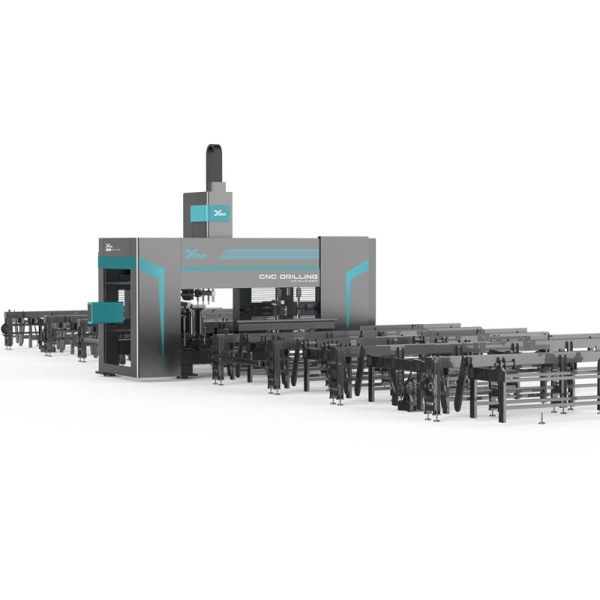
The 3D CNC Beam Drilling Machine from YOMI is model YM-3D1250. Its product page lists a beam web-height range of 200–1250 mm, maximum drilling thickness of 40 mm, maximum hole diameter of 40 mm, three 15 kW spindle motors, a 12 m effective feeding length, and maximum feeding speed of 9,000 mm/min. These specifications are a useful screen, but a buyer should convert them into a job-by-job fit check.
Confirm every profile you plan to run
Do not evaluate a CNC beam drilling line using only its headline H-beam range. The detailed page lists workpiece ranges for H beam, U beam, box beam, and angle steel, plus a 12/15 m or customized length option. It also lists automatic processing for material at least 3,000 mm long. Use those figures to classify your historic orders: common profiles, recurring specials, short pieces, and any sections that require alternate processing. This avoids paying for a line that looks broad on paper but leaves a costly percentage of work outside its comfortable operating range.
Material handling must be considered with the same care. The page lists a maximum feeding weight of 10 T (1 t/m) and a maximum workpiece width of 1,250 mm. Verify that your stock lengths, crane capacity, transfer tables, receiving area, and finished-part storage can support the intended sequence. Drilling capacity has little value if the next beam is not ready to feed or the completed beam cannot move safely out of the line.
Focus on hole requirements, not just hole diameter
The product page states a drilling-hole diameter range of Φ8–Φ40 mm and three drilling power boxes. It also gives a spindle-speed range of 30–3,000 r/min. These points help a buyer frame the discussion, but the supplier should test the actual hole patterns, material thicknesses, and feature density common in your work. Holes near ends, tightly spaced groups, different beam faces, and mixed section types can change cycle time and programming needs.
For quality planning, the page lists adjacent-hole-group accuracy of ±0.5 mm for distances under 640 mm and ±1.0 mm/10,000 mm for adjacent hole groups. Treat that information as an input to your acceptance criteria. Define the measurement method, part support condition, material condition, feature samples, inspection records, and corrective-action process before the purchase order is finalized. Quality expectations are easier to align during a factory acceptance test than after installation.
Make data compatibility a buying-gate item
Modern beam fabrication starts well before a tool touches steel. The YOMI page says the machine can support TEKLA 3D software DSTV files, online and offline programming, 3D graphics preview, automatic alarm display, and automatic fault diagnosis. Those features can help connect detailing to production, but your team still needs to validate the exact post-processing workflow. Ask to see your own DSTV files imported, reviewed, edited if necessary, released to the machine, and traced back to a finished beam.
Include the people who will own that handoff. Detailers should assess model-data quality; programmers should check nesting and exceptions; operators should assess the interface; and quality staff should understand how part identity is maintained. This small up-front review can prevent a sophisticated CNC drilling machine from becoming dependent on one specialist who knows how to correct every file manually.
Plan the line as a system
The product page describes auto feeding, a feed roller frame, and a finished-workpiece storage area. In a real plant, those elements need a layout plan with buffer space, crane paths, operator walkways, maintenance access, and an agreed method for sorting completed members. The page also lists mist cooling with three nozzles and compressed-air pressure of 0.5 MPa. Request the complete site-preparation and utility requirements early so commissioning is not delayed by missing services.
Calculate expected output using your own part mix, including setup, scanning or data release, loading, drilling, discharge, inspection, tool changes, and planned maintenance. Speed alone is not output. The right automated beam drilling system is one that runs predictably through a shift and delivers parts that move directly into fit-up.
To move from comparison to a defensible investment, share a sample order mix and DSTV files with YOMI and request a capability review of the 3D CNC Beam Drilling Machine. Ask for an application test, site-layout discussion, and acceptance plan based on your actual steelwork.
